Assessment / Speaking
Listen to the evidence.
Speaking assessment starts with captured speech. The transcript helps locate the language; the audio matters when deciding how it sounded.
What is assessed
Language in use.
RALE evaluates task completion, fluency, grammar and vocabulary, with pronunciation evidence where the acoustic measurement is available. Findings can be linked to a transcript span and an audio timestamp.
The raw transcript and a human-corrected transcript have distinct roles in the speaking specification. Teachers can accept, reject or edit proposed findings.
Standard speaking
A rubric for practice.
| Criterion | Evidence considered |
|---|---|
| Task Completion | Whether the learner responds to the task. |
| Fluency | The flow and continuity of the spoken response. |
| Grammar | Control and variety of spoken language structures. |
| Lexical / Vocabulary | The words used to express the response. |
| Pronunciation | Measured evidence of how speech sounds, where available. |
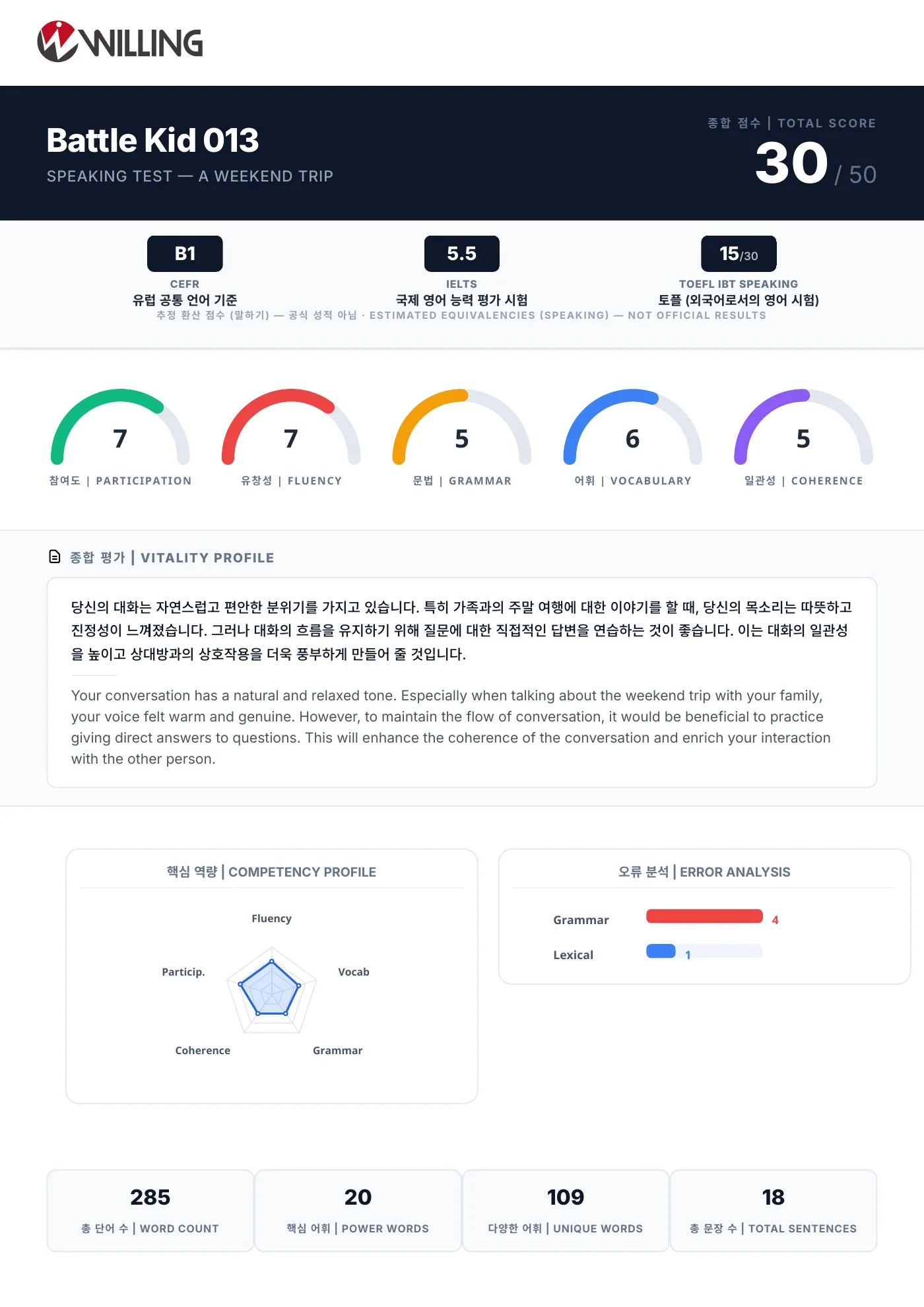
The documented Standard rubric is out of 50, with 10 per criterion. The current report renderer supports older stored criteria as well as the newer pronunciation-based rubric. The sample below uses the older Participation / Coherence layout.
In the Standard /50 conversation path, unavailable pronunciation is excluded and the remaining result is rescaled. Native Standard /100 has stricter measurement and publication gates. Missing measurement must not be presented as a measured score.
docs/architecture/domain_speaking_standard.mdmodules/speaking/services/conversation_scoring_service.pymodules/student_processing/services/pdf_service.pymodules/student_processing/publishing.pyIELTS speaking
A separate band rubric.
| Criterion | What is considered |
|---|---|
| Fluency & Coherence | Continuity and connection of ideas. |
| Lexical Resource | Vocabulary range and use. |
| Grammatical Range & Accuracy | Variety and control of grammar. |
| Pronunciation | Clarity and pronunciation features. |
The IELTS speaking path uses a 9.0 band scale. An estimated IELTS equivalency on a school practice report is a different output from an IELTS-path assessment, and neither is an official exam result.
docs/architecture/domain_speaking_ielts.mdscripts/seeds/scales/data_v2.py · IELTS Speakingtests/test_speaking_calibration.py · “no score at all when there is too little speech to judge”modules/speaking/services/conversation_scoring_service.py · evidence_verdictInside the report
Feedback with a review trail.
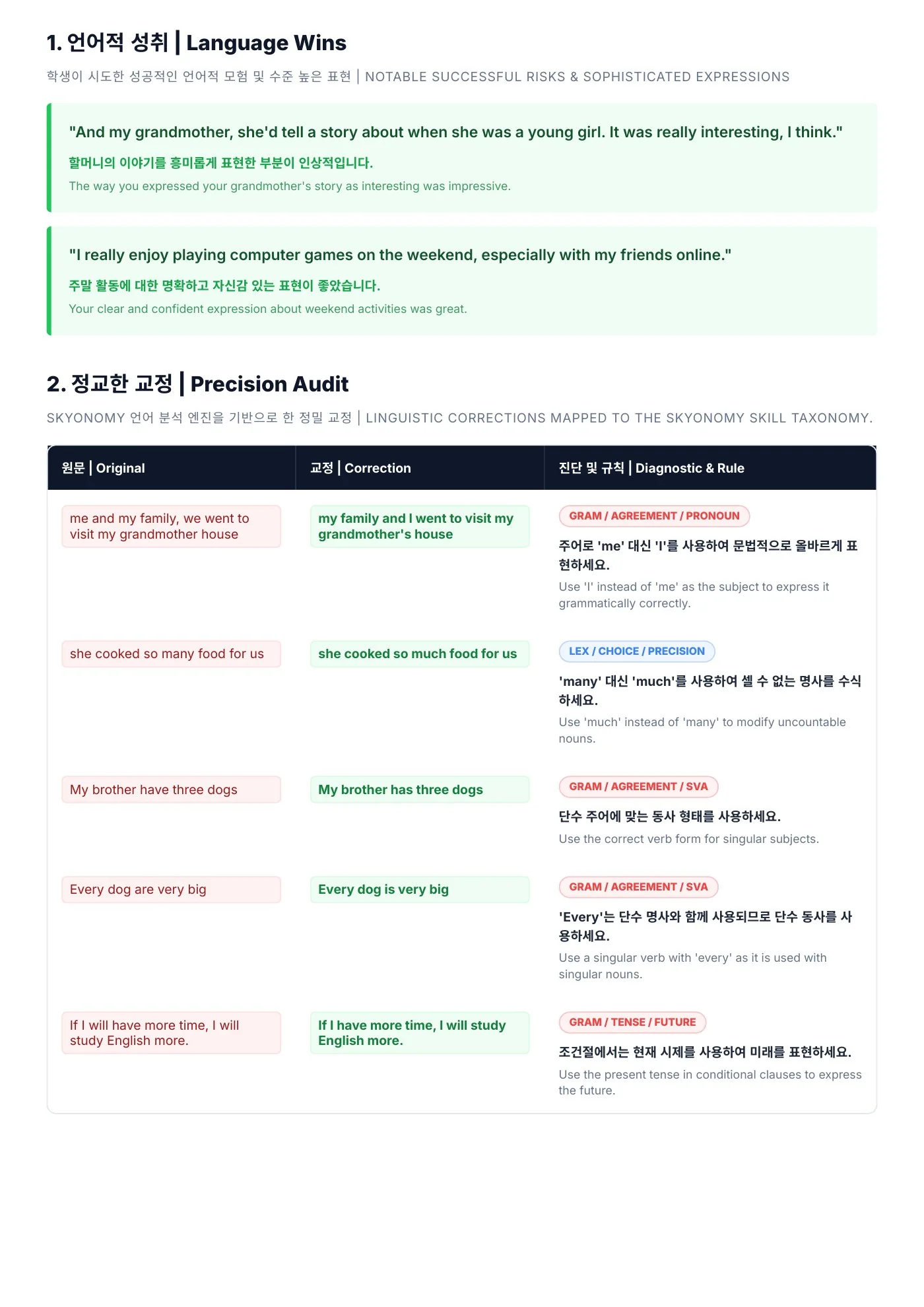
The supplied report contains a score profile, bilingual feedback, an error analysis, a Precision Audit and a next-step plan. The review specification distinguishes report approval, transcript review and audio verification; those levels should never be treated as interchangeable.
The real artefact
Read the sample.
This is a stored Standard speaking report, including its original labels and estimated equivalencies. It shows the report’s structure; its values should not be used to infer the current conversion rules or examiner agreement.

next-web/public/sample-report/speaking-1.jpg … speaking-3.jpgdocs/architecture/speaking_engine_spec.mdtests/test_speaking_calibration.py